
The Olfactory Fingerprint
What 510 people told us about the senses nobody measures
For World Taste & Smell Day, September 14, 2026
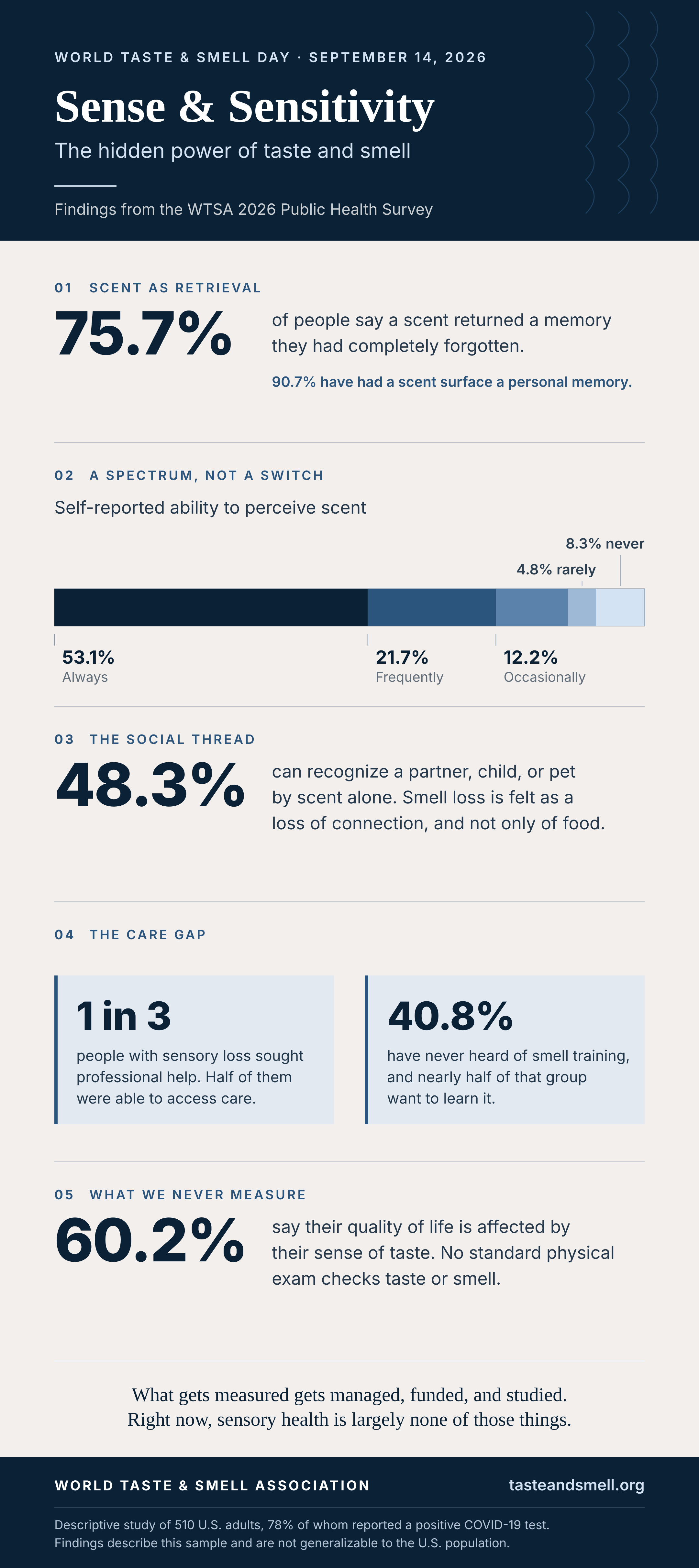
Fifty-three percent of the people we surveyed can smell reliably, all the time. That is the good news, and it is a smaller number than most people would guess about themselves and their neighbors. Everyone else sits somewhere along a gradient: 21.7% perceive scent frequently, 12.2% occasionally, 4.8% rarely. For 8.3%, there is nothing at all.
Those figures come from the World Taste & Smell Association's 2026 Public Health Survey, a descriptive study of hundreds of American adults. One thing to say plainly before anything else: 78% of respondents had tested positive for COVID-19. This is a self-selected, COVID-attuned population, and the percentages describe that group rather than the general public. What the survey does well is map the texture of chemosensory life among people who have had reason to pay attention. On World Taste & Smell Day, that map is worth reading closely.
The nose as retrieval system
90.7% of respondents have had a scent pull up a specific personal memory. 75.7% said a scent returned a memory they had completely forgotten.
The wiring explains a good deal of this. Olfactory input reaches the piriform cortex, amygdala, and hippocampus through very few synapses and without the obligatory thalamic relay that vision and hearing pass through. Emotion and memory get the signal early, before the slower machinery of naming and description catches up. That is why people can be flattened by a smell they cannot identify, and why the memory arrives whole instead of in pieces.
"For many, smell was not simply an input. It was a retrieval mechanism for autobiography, a way back into who they have been."
Lose the sense and you lose access to the archive. Patients describe this as a specific kind of amputation, and it is one reason smell loss tracks with depressive symptoms in clinical populations.
A spectrum, not a switch
Medicine tends to ask one question about smell: can you, yes or no. The distribution above argues for a better question, which is how well, measured against what.
Meaningful variation lives inside the so-called normal range. Someone at 21.7%-land, perceiving scent "frequently," is describing a life with holes in it that no clinic visit will ever surface, because nobody asks and no score exists in the chart. Worth adding that self-report is a blunt instrument here. Psychophysical testing routinely disagrees with what people believe about their own noses, in both directions. That is an argument for measurement rather than an argument against the finding.
The quiet infrastructure of attachment
48.3% of respondents can recognize a loved one by scent alone. A partner, a child, a dog. 42.8% take real comfort in the smell of a loved one's belongings, which is why the sweatshirt stays unwashed in the drawer. Nearly 40% said another person's olfactory presence can shift their own emotional state.
This is the part that gets left out of the clinical picture. Smell loss reads on paper as a food problem. In practice it is a relationship problem. People lose their infant's head, their partner's pillow, their mother's kitchen, and they lose it silently, because the vocabulary for describing that loss barely exists and the people around them have no way to see it. Caregivers feel this from the other side: the family member who keeps cooking for someone who can no longer taste any of it, and who has no guidance on what to do differently.
The educational void
85.4% of respondents believe scent can have therapeutic benefit. Then the pipeline collapses. Only about a third of people who experienced sensory loss sought professional help, and only half of those were able to access care.
The sharpest illustration is olfactory training. 40.8% of respondents do not know what smell training is. Nearly half of that group said they want to learn. Appetite across the whole sample runs at 51.6%. The intervention itself is cheap, home-based, and has the most evidence behind it of any non-pharmacological option available, with effect sizes that are modest and variable and still worth having. The failure here is distribution. The knowledge exists in the literature and never reaches the kitchen table.
We measure what we value
Blood pressure, cholesterol, A1C, visual acuity, hearing thresholds. Standard, cheap, charted, tracked over decades. Meanwhile 60.2% of people say their quality of life is affected by their sense of taste and 66.2% say aroma is essential to the food experience, and no physical exam in the country routinely checks either one.
"What gets measured gets managed, funded, and studied. Right now, sensory health is largely none of those things."
The consequences compound. Without a standard measure there is no baseline, without a baseline there is no trend, and without a trend there is no way to tie chemosensory decline to the outcomes it plausibly drives: malnutrition in older adults, gas and spoilage hazards in the home, the neurodegenerative signal that olfactory decline often precedes by years. Sensory health stays off the funding map because nobody can point to a number.
WTSA 2026 Report
Today
World Taste & Smell Day exists because a pandemic made the invisible briefly visible, and because that visibility fades fast. Here is what is useful today: eat something with your full attention and name what you find. Ask a person who lost their smell how it actually went for them, and listen past the first answer. At your next physical, ask your doctor for a sensory check and watch what happens when there is no protocol to reach for.
Fifteen years from now, a sensory vital sign in the standard panel seems entirely achievable. The harder question is what it should measure. Threshold, identification, hedonic response, retronasal function, or the thing people actually described in this survey, which is access to their own lives through their nose. Who gets to decide which of those counts as normal, and for whom?
The 2026 WTSA Public Health Survey is a descriptive study of 510 U.S. adults, 78% of whom reported a positive COVID-19 test. Findings describe this sample and are not generalizable to the U.S. population. Full methodology and instrument available from the World Taste & Smell Association. Interested in more on this? please email hello@TasteAndSmell.org to request a copy of the full report and support our work.
